This debate was somewhat one-sided, since Dr. Chervin brought fairly well-worn Aquinian arguments to her opening and didn't seem particularly well-prepared for any of the segments thereafter. However, it is worth listening to the beginning, because Vacula does an outstanding job of unleashing a relatively new sort of one-two punch: (1) An evidential argument from evil, followed by (2) Stephen Law's evil god hypothesis as premptive counter-theodicy. Enjoy!
Friday, August 31, 2012
Vacula vs Chervin on NEPA podcast
This debate was somewhat one-sided, since Dr. Chervin brought fairly well-worn Aquinian arguments to her opening and didn't seem particularly well-prepared for any of the segments thereafter. However, it is worth listening to the beginning, because Vacula does an outstanding job of unleashing a relatively new sort of one-two punch: (1) An evidential argument from evil, followed by (2) Stephen Law's evil god hypothesis as premptive counter-theodicy. Enjoy!

Thursday, March 15, 2012
Smith vs. Kern at OCCC
Just a few thoughts and takeaways on the debate last week between scientist Abbie Smith and pastor Steve Kern here in OKC.
This debate ostensibly centered around a policy question on what should be taught in public schools, but it immediately and perhaps inevitably came down to a contest between scientific and religious views of human origins. At this event, opposing views were not merely discussed, but physically symbolized by the opposing speakers. The age-old struggle between science and religion found itself incarnated in two persons: Science presented as forward-looking, edgy, smart, young, stylish and sexy; religion presented as the polar opposite on all points. Science rides in on a motorcycle, carrying a slide deck on a colorful MacBook, and talks excitedly of continually expanding the scope of human knowledge. Religion, by contrast, shows up in a grey-toned suit, with a sheaf of paper notes, and talks phlegmatically of how we'll never surpass the cosmogony of the Bronze Ages. At this point one might be forgiven for assuming that the debate was not merely organized, but actually choreographed.
The substantive content itself turned out to be overwhelmingly, almost sadly, one-sided. The only way for an ID-advocate to come off well in a public debate is to dive way down into the weeds using technical jargon in order to create the false impression of expertise to an audience of laypersons. For example, William Dembski can throw out a load of advanced (albeit misapplied) mathematics to back up his idea that it's virtually impossible to add useful information to complex genotypes, thereby obscuring direct evidence that this has in fact happened time and again by various processes (some of which were central to Smith's argument for common descent). Kern does not have a background in mathematics or microbiology or any other scientific field, so he is unable to avail himself of the jargon fire-hose gambit. He might could have gone for a Gish-gallop, but probably lacked the background to pull that off as well. Abbie's previous opponent was more formidable on all counts, and that is about the most damning thing I've ever written in any context.
Many people have asked me what the point is in holding debates at which the audience is already firmly in the tank for one side from the get-go and few people are lead to change their thinking significantly during the course of the evening. The answer to this is that the live audience isn't really the intended audience. The real audience is the YouTube audience, students who will hear one view in their biology classes and a different story entirely on Sunday morning, and need to see how a faith-based and reason-based stack up against each other when put head-to-head. The real audience are our children and their peers, those who will decide whether America will ultimately fulfill the theocratic vision of its Puritan forebears or the scientific vision of its Enlightenment Founders. Far more people will see this event online than in person, and with any luck it will help to tilt the balance in favor of truth, justice, and the scientific method.
Unbeliever rating: 4.5 stars
Believer rating: 1.5 stars
Overall rating: 3 stars
Monday, June 6, 2011
PZ Myers vs. Hamza Tzortzis in Dublin
This is a very strange debate in terms of setup (spontaneous confrontation on a Dublin street) but I still have to count it in because of the stature of the two debaters in terms of their following in their respective communities.
PZ leads off by trashing an Islamic pamphlet, which prompts Hamza to start in on the KCA for a bit, but PZ quickly changes the subject to emphasize evidential arguments rather than philosophical arguments grounded in everyday metaphysical and causal intuitions. They dabble in rudimentary epistemology for a bit, and eventually Hamza starts in on the glorious revelation that is the Quran, with emphasis on the specifics of embryology. They go on about this for quite awhile, with the Muslims making the usual argument that the Koran is just too advanced to be the product of their founding prophet writing without the benefit of divine revelation.
Overall, this one was pretty fun to watch, if not particularly groundbreaking. I'd love it if this sort of thing happened every Friday night in Bricktown.
Thursday, May 12, 2011
Hitchens vs. Lennox in Edinburgh
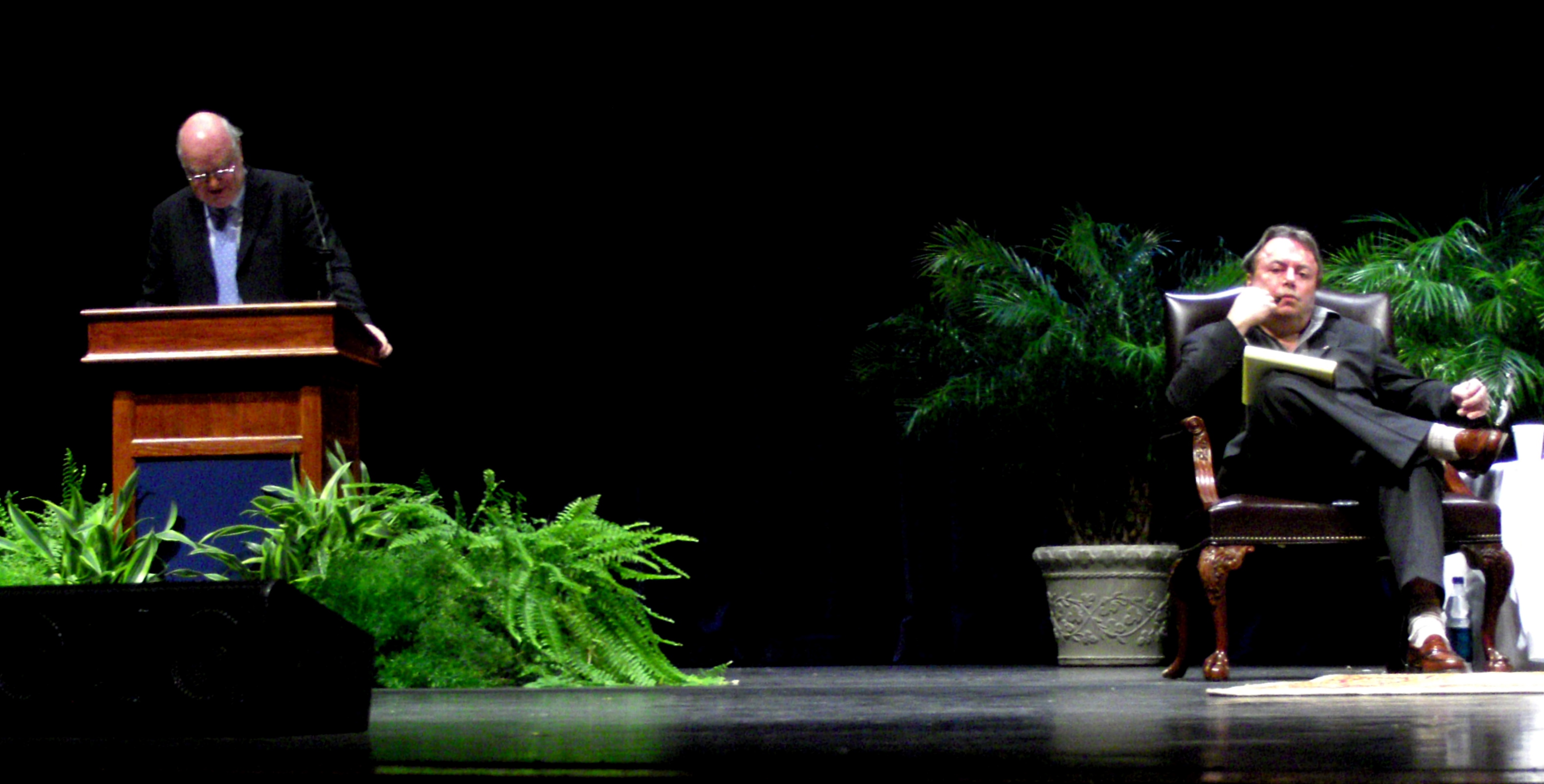
Christopher Hitchens debated John Lennox at the Edinburgh International Festival, on whether atheism will provide a viable future for Europeans. The file is available for purchase online, but I don't recommend that anyone buy anything from the Fixed Point Foundation. There are far too many free files available of comparable or superior quality to their events.
Christopher Hitchens leads by arguing that terrible things have happened in Europe as a result of religion, and then he makes the giant leap that only secularism can save the day. He might well be right, but he did not deductively or inductively connect his conclusion to his premises. It may well be true that Abrahamic religion poisons everything European, but this does not logically imply that either secularism or atheism will have a good shot at salvaging Europe from a rising tide of fundamentalism both Christian and Muslim.
John Lennox makes the case that the so-called "New Atheists" have confused the essential message of Christianity with the abuses perpetrated by the political powers of Christendom, which is at least partly true, and is undoubtedly true in the case of Hitchens himself. It is surely irrational to tar one’s opponents with too broad a brush, however, in the next breath Lennox writes off all secular moral reasoning as mere post-modern chatter, thus committing precisely the same breach of reasoning and etiquette, confounding his opponent’s actual positions with those of his least admirable comrades. It gets worse, however; as he goes on to confound humanism with communism. At this point, it becomes clear that this man may safely be dismissed as a wellspring of serious criticism. He eventually gets around to making an argument that we have to assume that the universe was created in order to discover that it is intelligible. He goes on to talk about ethics for just a bit, claiming that our innate revulsion at certain actions must come from the God of Abraham rather than mere natural selection, an argument which might work on audiences ignorant of both cultural anthropology and the fallacy of the false dilemma. He closes by saying that if we cannot have eternal Heavenly justice, there is no point at all in seeking temporal Earthly justice. In summary, Lennox sounds almost as rhetorically smooth as Hitchens, but his arguments are somehow even less coherent.
The rebuttals are muddled and scattershot, but what else might one expect, given the lack of argument heretofore?
Overall, this debate elevates style over substance and rhetoric over logic. This is (alas) not terribly unusual in such debates, but this event really takes it to a whole new level. Both speakers manage to sound quite intelligent without ever making even one inductively or deductively valid argument. Good lord below, I’ve done my mind a disservice by slogging through this one.
Christopher Hitchens leads by arguing that terrible things have happened in Europe as a result of religion, and then he makes the giant leap that only secularism can save the day. He might well be right, but he did not deductively or inductively connect his conclusion to his premises. It may well be true that Abrahamic religion poisons everything European, but this does not logically imply that either secularism or atheism will have a good shot at salvaging Europe from a rising tide of fundamentalism both Christian and Muslim.
John Lennox makes the case that the so-called "New Atheists" have confused the essential message of Christianity with the abuses perpetrated by the political powers of Christendom, which is at least partly true, and is undoubtedly true in the case of Hitchens himself. It is surely irrational to tar one’s opponents with too broad a brush, however, in the next breath Lennox writes off all secular moral reasoning as mere post-modern chatter, thus committing precisely the same breach of reasoning and etiquette, confounding his opponent’s actual positions with those of his least admirable comrades. It gets worse, however; as he goes on to confound humanism with communism. At this point, it becomes clear that this man may safely be dismissed as a wellspring of serious criticism. He eventually gets around to making an argument that we have to assume that the universe was created in order to discover that it is intelligible. He goes on to talk about ethics for just a bit, claiming that our innate revulsion at certain actions must come from the God of Abraham rather than mere natural selection, an argument which might work on audiences ignorant of both cultural anthropology and the fallacy of the false dilemma. He closes by saying that if we cannot have eternal Heavenly justice, there is no point at all in seeking temporal Earthly justice. In summary, Lennox sounds almost as rhetorically smooth as Hitchens, but his arguments are somehow even less coherent.
The rebuttals are muddled and scattershot, but what else might one expect, given the lack of argument heretofore?
Overall, this debate elevates style over substance and rhetoric over logic. This is (alas) not terribly unusual in such debates, but this event really takes it to a whole new level. Both speakers manage to sound quite intelligent without ever making even one inductively or deductively valid argument. Good lord below, I’ve done my mind a disservice by slogging through this one.
Hitchens vs Richards at Stanford U.
Christopher Hitchens debated Jay Richards (video, audio) over the particular question of theism versus atheism, but they managed to stray far and wide during the course of the event.
As usual, Hitchens puts out a crazy salad of very well-worded emotional appeals, but doesn't bother to show how any of his arguments should lead one to conclude either materialism or deism. He leave the hard work of sorting out his facts into an argument with a conclusion to his listeners, which I suppose may be an acceptable mode of instruction at an institution such as Stanford. Nevertheless, I was (as always) far more impressed with his style than with his substance. Even when he alludes to a good argument (e.g. the problem of evil) he doesn't flesh out the deductive structure thereof.
Richards, by contrast, gives several facially valid arguments in rapid succession, and appeals to natural human intuitions (such as the intuition that moral statements are universally binding, or the intuition that everything that begins to exist has a cause, or the intuition that anthropic coincidences must imply design) to make his case both efficiently and effectively.
As usual, Hitchens recovers significantly during the Q & A, but he never comes close to countering the serene and methodological approach of his opponent, and his frustration (or lack of sobriety) shows through on a few occasions. It was a bit sad to watch, really. With the exception of the Hitchens/Craig debate, I've never seen the Hitch so thoroughly beaten.
Overall rating: 3.5 stars
Believer rating: 5 stars
Unbeliever rating: 2 stars
As usual, Hitchens puts out a crazy salad of very well-worded emotional appeals, but doesn't bother to show how any of his arguments should lead one to conclude either materialism or deism. He leave the hard work of sorting out his facts into an argument with a conclusion to his listeners, which I suppose may be an acceptable mode of instruction at an institution such as Stanford. Nevertheless, I was (as always) far more impressed with his style than with his substance. Even when he alludes to a good argument (e.g. the problem of evil) he doesn't flesh out the deductive structure thereof.
Richards, by contrast, gives several facially valid arguments in rapid succession, and appeals to natural human intuitions (such as the intuition that moral statements are universally binding, or the intuition that everything that begins to exist has a cause, or the intuition that anthropic coincidences must imply design) to make his case both efficiently and effectively.
As usual, Hitchens recovers significantly during the Q & A, but he never comes close to countering the serene and methodological approach of his opponent, and his frustration (or lack of sobriety) shows through on a few occasions. It was a bit sad to watch, really. With the exception of the Hitchens/Craig debate, I've never seen the Hitch so thoroughly beaten.
Overall rating: 3.5 stars
Believer rating: 5 stars
Unbeliever rating: 2 stars
Monday, April 11, 2011
Harris vs Fraser in London
http://www.intelligencesquared.com/events/sam-harris/
Sam Harris leads off with three reasons that people argue he is wrong about the (essentially utilitarian) nature of moral talk:
- At least some religions are true
- At least some religions are useful
- Atheism is unpleasant and corrupting
Harris rejects these contentions and goes on to present essentially the same opening statement as he did in his recent debate against W.L. Craig, making the case that the science of ethics is essentially a systematic study of how to maximize mental health, just as the science of medicine is essentially a systematic study of how to maximize physical health, and neither should be considered unscientific on account of the fact that both fields strive to maximize human well-being in an attempt to fulfill widely shared values.
Giles Fraser leads off with a bizarre and highly metaphysical critique of utilitarianism, bringing out the nasty old utility-monster from some dark corner of his mind. For some reason, Fraser considers this retort so effective that he doesn't really expound upon any other critique.
Harris and Fraser go back and forth on this a bit, and Harris basically concede that beings who are more richly capable of joy and suffering really should count for more than beings (e.g. cockroaches) who are less capable of such subjective experiences. I'm confused as to why Fraser thinks this is such a problem, unless he is suggesting that theism is basically the same as utility-monsterism. Perhaps this might yet be so, if the Campus Crusade for Cthulhu ever gets their way.
The debate goes downhill a bit from here, until Fraser and Harris get into it over the nature and utility of moral philosophy in general. On this point, Harris does three interesting things: he explains why he avoids the traditional modes of philosophical ethical talk, he clarifies that he does indeed consider himself a philosopher, and declares that he is willing to personally engage the traditional moral philosophers, even if he refuses to write books as they do.
Fraser's next serious challenge is about Harris' repeated use of the phrase "conscious creatures" but it falls fairly flat when Sam explains that he is simply making room for the possibilty of non-human suffering.
I've got to comment for just a second on the first question in the Q&A. This smarmy little bastard stands up and says "What is the scientific reason to care about the well being of conscious creatures?" I'm beginning to lean towards the notion that there is only one correct answer to this question, and it is to walk calmly over to the questioner, stop calmly just short of an arm's length away, and bitch-slap his ass into next week. After all, if he has the sheer cheek to seriously suggest that I should not be concerned about his subjective experience of suffering, why not just take him at his word? I've got to admit, though, that the answer given by Harris was more cogent and persuasive.
Overall, it was a good talk, but it was clear that Harris performs significantly better when up against a worthy opponent such as Craig than he does when facing, well, someone like Fraser.
Friday, April 8, 2011
Harris vs. Craig at Notre Dame
Last night I was well-filled with cheap pizza and pricey booze, and much like the Biblical character Boaz on the threshing floor, perhaps not in the best possible condition to make a dispassionate and rational assessment of the situation. With that caveat out of the way, I have to say that I thought Sam Harris pretty much held his own against William Lane Craig last night. I'll put up a more detailed review whenever I find an mp3 copy, but here are my first impressions for now.
Openings
Craig makes the argument that morality must be objective, not in the usual sense of the term, but rather in the sense of being universally binding upon all persons on account of what he calls a "Competent Authority" by which he means the God of Abraham, Moses, and Jesus. Here is the argument in deductive form:
1. Objective morality requires moral rules laid down by God.
2. Objective morality, in this sense, really does exist.
3. Therefore, God exists.
The argument is deductively valid, but both of the premises are evidently false. Craig's argument for the first premise is essentially that morality can only be understood as a set of rules laid down by an authority figure. He begs the question really hard here, but he does it with the flair of a showman and the conviction of a true believer. Craig's argument for the second premise relies on the audience not noticing when Craig makes the subtle shift from the almost universal moral outrage at the examples he provides to the idea the we cannot be properly outraged unless God is as well. Okay, well it doesn't sound at all subtle when I put it that way, but I promise he does is smoothly.
Harris, for his part, tries to make the case that we should not think of morality as binding rules handed down from above, but rather as a set of ideas derived from our best scientific understanding of how to bring about the flourishing (and avoid the suffering) of conscious and sentient creatures such as ourselves. He makes a strong analogy with the field of medicine and the idea of health versus illness. We assume that health is better for everyone, then we use science to derive ideas about how to get there, e.g. stop smoking, do your cardio, eat your vegetables, wear your rubbers, etc.
If you want a better sense of Harris' opening statement and basic arguments, you can have a look at this video or others like it, in which he stakes out his position and unpacks a sort of simplified utilitarianism for the 21st century.
Rebuttals
During the rebuttals, I noticed that Craig retreated a bit further into philosopher mode, in which he seems to assume that everyone in the audience is taking an undergraduate degree in philosophy and can understand what he is saying even when he doesn't bother define his terms. Meanwhile, Harris stuck with plain language, powerful analogies, and memorable one liners. He also takes a direct shot or two at Catholicism at Notre Dame. He falls short just a bit, though, when he failed to make it perfectly clear that this debate ultimately consists of a sematical struggle over what it means to act morally. The entire debate can be summed up thusly:
WLC: Morality consists in following rules issued from above
SH: No, morality consists in helping people because we happen to like people.
WLC: No, no no, it is all about binding rules from a Competent Authority.
SH: There is no such Authority, and have your read those rules? They are God awful.
WLC: OBEY GOD'S RULES!
SH: HELP OTHER PEOPLE!
And so forth. Basically, it comes down to the question of whether we are morally motivated by fear of God or by the love of people, and I have trouble believing that anyone showed up to the debate truly agnostic on this issue, because one has to settle the question of whether any gods exist before you can really get on with the moral arguments. I agree with John Loftus that the best anyone can do against Craig is break even, but I have to give Sam Harris major props for very nearly doing so, especially on a topic like morality, where both our language and our intuitions are strongly biased towards a dualistic and theistic understanding.
Wednesday, March 30, 2011
Krauss vs Craig at NCSU
Every time Craig debates someone new, I get my hopes up that maybe this time he will have finally met his match. Alas, I am consistently disappointed, and this event proves (yet again) that scientific genius and lecturing skills are not sufficient for debate.
Opening statements
Craig leads with five arguments, as usual, almost but not quite the usual five. Is he evolving, perhaps just a little bit?
His second argument relies on the impossibility of actual infinite regress. Seems like this argument should conclude that space-time itself is finite and bounded, rather than divinely ordained, but Craig manages some clever rhetorical legerdemain here to distract the audience from this conclusion and over to the theistic hypothesis. He slides into a basic Kalam argument here, in which (as per usual) he equivocates between "cause" meaning what it is usually taken to mean, that is "natural forces rearranging existing matter into new form over time" and instead uses the term in a completely different novel and metaphysical sense. I know he has been called out on this before, so it seems downright dishonest at this point to keep banging on the same old drum.
His third argument is the usual argument from fine-tuning. The key premise here is this: "We now know that life-prohibiting universes are incomprehensibly more probable than any life-permitting universe." How can we know this? To calculate the probability of any given event, we need to have enough samples of that event taking place in order to mathmatically estimate the probability density function of the underlying natural process, this is essentially what we mean when we use the word probable in its technical sense. What Craig is implicitly claiming here is that he has observed so many universes created that he now has a good sense of which particular fundamental universal constants determine all the major features of a universe, the ranges of those few fundamental constants, and what their histograms look like within their possible ranges. Sythesizing all these observations together, Craig can mathematically estimate the apriori probability of an ensemble of fundamental constants which would allow for some variety of self-reproducing molecules, carbon-based or otherwise. In other words, Craig has the sort of knowledge which we might only expect of all-knowing transcendent beings, since these are the only sort of conscious observers who could possibly witness multiple universes coming into being and either generating life or failing to do so. Therefore, we can safely assume that if Craig is indeed correct in his unique assertion of precise mathematical knowledge regarding the probability distrubition of fundamental universal constants, He is in fact God incarnate. QED.
Craig's fourth argument is the usual argument from objective moral values. It goes like this:
- If God does not exist, objective moral values cannot exist
- But objective moral values do exist
- Therefore God exists
Craig's fifth and final argument is the argument from the gospels. He makes his usual minimal facts argument, by which he takes certain of key facts of the gospels to be true and thereby concludes that other key facts from the gospels are also true. Of course, there are plenty of biblical scholars who see it very differently. Krauss starts out his case by making it clear that he intends to be combative and even a bit of an arse. That doesn't bode well, and it goes a bit downhill from there, when Krauss starts lecturing on QM, a subject which I usually enjoy. Once again, it seems that Dr. Craig showed up for a debate while his learned opponent cannot help but fall back into lecture mode. Por el amor de Dios, why does this keep happening? Does no one ever heed Luke's warning? Does Krauss actually make any coherent atheological arguments at all? Eventually, Krauss stops lecturing and gets around to attempting a few rebuttals of Craig's alleged evidence. Just for reference this is what a rebuttal should look like:
- Here is the key premise in my opponent’s argument: *quotes premise*
- Here is why it is false: *makes argument*
Rebuttals
Craig cannot seem to find any particular argument to rebut, so he just picks out a few particualr claims made by Krauss and rebuts those. For example, he takes apart the notion that nothing is unstable. He also has a go at both Krauss' moral views, claiming that without Someone transcendant to whom humans are finally morally accountable, morality must be ultimately down to our own human values. Krauss leads his rebuttals with the statement that we do not know how the universe began, and we should do more science on the problem rather than simply filling in the epistemic gap with a divine miracle. This is actually a fairly decent retort to both the cosmological and teleological arguments, both of which depend upon a default to theism in the lack of a working scientific theory. Such a theistic default may well be irrational, but Craig has "common sense" on his side here, as evidenced by the fact that almost all human cultures continually propogate the meme of immaterial minds.
Throughout the rebuttal periods, Craig continually calls out Krauss for failing to rebut his opening, and eventually Krauss gets around to addressing most of it. Some of this he does well, some of it not so well. Krauss is clearly comfortable talking about cosmology and much less so when dealing with philosophy and history. Even so, Craig manages to hold his own on account of a fundamental asymmetry built into the nature of cosmology. It would take Krauss a load of time to properly flesh out a working multiverse hypothesis and connect it to first principles of quantum mechanics, but it only takes Craig half a minute to appeal to human intuitions about infinity and first causes.
Lessons learned
I've always said that no one should debate Craig without first reading up on his usual arguments and coming prepared to rebut them swiftly and effectively. That applies here as well, and it is clear that Krauss did not take Craig seriously enough to prepare for his usual arguments, since the only arguments that were well-rebutted were those in Krauss' own area of expertise, that is, fine tuning and cosmology. But there is another lesson here: Never go into a debate in which you are called upon solely to rebut the evidence for theism. Krauss never once makes an affirmative case for naturalism, and it is unclear whether this is due to unpreparedness on his part or because of the way he allowed the debate to be framed. Either way, it is damn sloppy.
Overall rating: 3.0
Believer rating: 4.5
Unbeliever rating: 1.5
Monday, March 28, 2011
Dillahunty vs. Comfort on the Atheist Experience (radio)
I don't usually watch or listen to The Atheist Experience, but on the advice of a good friend of mine, I listened to the latest episode this morning, in which the hosts go back and forth with Ray Comfort on any number of issues, including the Bible, creation/evolution, abortion, true Christianity, direct knowledge of God, moral arguments, the existence of souls, and so on. Basically they run the whole gamut, with Ray making arguments and the hosts shooting them down. As usual, Ray Comfort is invincibly ignorant and unable to muster a single cogent argument which doesn't simply beg the question that he is addressing. All attempts to provide him with either facts or counterarguments roll off his back like water off a croco-duck. Also as usual, the show hosts are well-prepared but scattershot. They don't focus on any one issue long enough to be enlightening, with the single exception of a lengthy remediation covering 10th grade biology. There is one lesson to be learned here, however, and it is this: Skeptics will inevitably sound uncertain when compared with true believers, because people of faith demand certainty and then hold on to that certainty despite any evidence. Skeptics demand doubt, and are constantly willing to reassess theories.
Friday, February 25, 2011
Prescott vs. Kern on Christian Nationalism

Last night, Drs. Kern and Prescott debated whether the U.S. Constitution had founded a Christian Nation. Here is the abridged audio, and here is the full video.
After listening to the debate, a few questions naturally spring to mind. Perhaps most saliently, one must ask what exactly are these uniquely Christian principles upon which Dr. Kern rested so many of his arguments? Are there any moral principles which one finds in the sayings of Jesus of Nazareth which are not to be found elsewhere in pre-Christian religions (e.g. Animism, Buddhism, Confucianism, Dionysianism, etc.)? If so, where are these uniquely Christian principles to be found in the U.S. Constitution?
Secondly, why should the letters or speeches of individual founders (e.g. Patrick Henry or Gouverneur Morris) be considered final and authoritative as to the interpretation of the U.S. Constitution, especially when said founders were expressing themselves on matters unrelated thereto? If modern church-state integrationists do not consider it acceptable to take Jefferson's "wall of separation" metaphor to be authoritative because it was written in a private letter to a Baptist church, why should Morris' unpublished draft of a Constitution for France carry more weight? At least it may be said of Jefferson that he was reflecting upon the potential of the First Amendment to the U.S. Constitution. By contrast, Morris was proposing a wholly new set of rules for a strikingly different cultural context, even as (back across the pond) the original thirteen States were busily discussing and ratifying the First Amendment.
Finally, it should be noted that Dr. Kern brings up a completely new topic when he moves on from the Constitution and its drafters to the late 20th century, attempting to draw a causal connection between secularism and some of the more unfortunate consequences of the sexual revolution. This is a fascinating topic in and of itself, and while it is irrelevant to the debate last night, might well merit further inquiry in another forum.
Overall, both men did a fine job of defending their respective positions, however, Dr. Kern had a much harder time of it because the facts were almost wholly against him, given that the proposition under contention was about whether the Constitution was intended to found a secular or religious republic.
Saturday, February 5, 2011
Law vs. McGrath on the radio (UK)
While this show is founded on a concept which I find irresitably appealing (Christians and non-Christians in conversation and debate), I've found myself generally critical of the show for failing to achieve intellectual and airtime balance between the unbelieving guest and the apologist(s) for religion. This episode is a happy exception, in which both debaters are equally bright and articulate. I definitely recommend this episode, if not the entire podcast.
Alister McGrath defends the ideas he has published in Why God Won't Go Away while Stephen Law assures that McGrath has to put up a geniune defense. They also manage to agree on some key propositions about how discourse and debate ought to be conducted. They also go back and forth a bit on theodicy and the problem of evil, which is clearly one of Law's pet arguments.
There is a fantastic bit around half an hour into the show when Law poses the following question, "What it is, actually, that the Holy Inquisition, Hitler, Stalin, Mao, Pol Pot, all had in common?" Well, that is something to chew on.
Alister McGrath defends the ideas he has published in Why God Won't Go Away while Stephen Law assures that McGrath has to put up a geniune defense. They also manage to agree on some key propositions about how discourse and debate ought to be conducted. They also go back and forth a bit on theodicy and the problem of evil, which is clearly one of Law's pet arguments.
There is a fantastic bit around half an hour into the show when Law poses the following question, "What it is, actually, that the Holy Inquisition, Hitler, Stalin, Mao, Pol Pot, all had in common?" Well, that is something to chew on.
Friday, February 4, 2011
Williamson vs. Craig at University of Saskatchewan
If you've already seen the earlier debate between these two men, you'll find this debate to be highly repetitious of those same arguments. At least Williamson seems a bit more prepared this time.
Craig starts out very strong, giving his usual five highly-polished arguments for theism. No surprises there.
Williamson starts out weak, fumbling about for a bit, speaking haltingly, and seemingly generally ill-prepared. I experienced a sinking feeling at this point, but he goes on to put together a few interesting arguments, one of which was an unusual presentation of a form of incompatible properties argument. Points for novelty at least.
On rebuttal, each speaker does a fine job ot tearing apart their opponent's arguments. Indeed, Williamson's rebuttal demonstrates that he did his homework, immediately singling out one of Craig's premises and demonstrating how that particular premise begs the question in favor of theism, and giving some reasons to doubt the premise itself. This is generally a good model for how to rebut deductive arguments put forward for theism. (His rebuttal of the fine-tuning argument could have been better, by providing an argument showing how the universe may have been naturally finely-tuned, and not conceding so much ground to Craig.)
Here is an example of what that rebuttal technique might look like in practice:
Craig's argument from objective moral values assumes that morality can only be "objectively real" if it is grounded in the mind of a transcendent moral being, which we call God. Thus, by claiming that morality is indeed objective (in this peculiar sense of the term) Craig is claiming that god exists, right up front in one of his premises. But this is precisely the question under discussion, and so we should be debating instead about the actual nature of moral value, rather than simply assuming that they are transcendent in the theistic sense which Craig supposes.
After the rebuttal period, the two debaters cross-examine each other for awhile, a format which I always enjoy. Craig gets the better of Williamson here, but it wasn't terribly one-sided.
Overall, it was a decent debate in which both sides were examined in some depth, but better arguments for naturalism exist, and may be found in better debates.
Here is another view.
Overall rating: 4.0
Believer rating: 4.5
Unbeliever rating: 3.5
Craig starts out very strong, giving his usual five highly-polished arguments for theism. No surprises there.
Williamson starts out weak, fumbling about for a bit, speaking haltingly, and seemingly generally ill-prepared. I experienced a sinking feeling at this point, but he goes on to put together a few interesting arguments, one of which was an unusual presentation of a form of incompatible properties argument. Points for novelty at least.
On rebuttal, each speaker does a fine job ot tearing apart their opponent's arguments. Indeed, Williamson's rebuttal demonstrates that he did his homework, immediately singling out one of Craig's premises and demonstrating how that particular premise begs the question in favor of theism, and giving some reasons to doubt the premise itself. This is generally a good model for how to rebut deductive arguments put forward for theism. (His rebuttal of the fine-tuning argument could have been better, by providing an argument showing how the universe may have been naturally finely-tuned, and not conceding so much ground to Craig.)
Here is an example of what that rebuttal technique might look like in practice:
Craig's argument from objective moral values assumes that morality can only be "objectively real" if it is grounded in the mind of a transcendent moral being, which we call God. Thus, by claiming that morality is indeed objective (in this peculiar sense of the term) Craig is claiming that god exists, right up front in one of his premises. But this is precisely the question under discussion, and so we should be debating instead about the actual nature of moral value, rather than simply assuming that they are transcendent in the theistic sense which Craig supposes.
After the rebuttal period, the two debaters cross-examine each other for awhile, a format which I always enjoy. Craig gets the better of Williamson here, but it wasn't terribly one-sided.
Overall, it was a decent debate in which both sides were examined in some depth, but better arguments for naturalism exist, and may be found in better debates.
Here is another view.
Overall rating: 4.0
Believer rating: 4.5
Unbeliever rating: 3.5
Saturday, January 1, 2011
Does science make belief in God obsolete?
Sunday, November 28, 2010
Muehlhauser vs. Gressis on CPBD podcast
I don't usually review podcasts on this blog, but this episode of Conversations from the Pale Blue Dot is absolutely worth a listen. It is probably best characterized as a causal discussion about the respective worldviews of Christian theism and metaphysical naturalism, but with a much lower level of animosity and significantly higher level of philosophical rigor than one can reasonably expect from a formal debate. The two interlocutors go back and forth, discussing sundry topics and questioning each other freely and spontaneously. I'd prefer to hear more debates adopt this format, at least for 20-30 minutes following the opening statements.
Tuesday, November 23, 2010
Kaminer vs Otitoju on the IQ2 (podcast)
http://www.intelligencesquared.com/quick-debates/protecting-free-speech-is-more-important-that-preventing-hate-speech
Freethinker and civil rights activist Wendy Kaminer makes a clear and cogent argument for untrammeled free speech, while Femi Otitoju makes the consequentialist argument that hate speech leads to more hate and invariable more hateful and hurtful actions. Strong arguments presented well from on both sides, on a vital issue which should be of interest to all right thinking people.
Alas, it is a rather short debate (didn't even last for my entire one-way commute) but certainly it is well worth the time.
Tuesday, November 16, 2010
Dillahunty vs. Jacobse at UMBC
This debate flows primarily from a difference of opinion regarding what the word 'morality' should be taken to mean. Predictably enough, the atheist believes that morality is an instrumental package of norms useful for humans to get along and thrive on Earth, while the theist believes that morality is a set of transcendent truths which exist in a supernatural realm accessible to us only by mystical experience or divine revelation. They each make their respective cases reasonably well, but for the most part they are talking past each other about different ideas.
Both speakers are notably jolly and upbeat, which is a nice change of pace. Possibly this is the most friendly debate I've seen since the one at UCO back in 2003. I'm sure that I've never heard someone accuse atheism of the 20th century genocides in such a friendly and deferential manner as Fr. Jacobse.
On a side note, the video production values on this are through the roof for a student-produced YouTube video, which bumps my rating up just a bit.
Saturday, November 13, 2010
Law vs. Plantinga on the radio (UK)
Alvin Plantinga leads with the idea that naturalism does not entail the observation of fine-tuning in the universe, whereas theism makes fine-tuning probable. I have to point out here that (as brilliant as he is) he gets this perfectly backwards. On naturalistic monism, observers cannot possibly exist unless at least part of some universe is so finely tuned as to allow for them to evolve naturally. On theistic dualism, observers exist as minds entirely apart from any sort of fine-tuned cosmos which might allow for the possibilty of organic matter walking about and pumping blood to their brains. In short, naturalism necessitates the observation of fine tuning, if naturalism is true and any actual observers exist at any time and place in any universe. By contrast, theism is not linked to fine-tuning at all, unless we include the downright bizarre premise that the god of theism is a bit of a deistic chap, and prefers to create a seemingly naturalistic world which runs all by itself according to fixed natural laws.
That aside, Plantinga came on the show not to confuse the listeners about cosmological fine-tuning, but rather to confuse them about the relationship between metaphysical naturalism, evolution, and the probability of some animals evolving reliable cognitive mechanisms. This he does quite well, by repeating the startingly claim that animal behavior is causally unrelated to animal beliefs about the world. Why does a cat or a dog or a human jump back and start pumping adrenaline when confronted by, say, an angry mama grizzly bear? Surely it is not because they believe themselves to be in danger. It must be for some other reason driven by neurology alone, without any regard to subjective experience. This decoupling of subjective experience and beliefs from behavior is the sort of thing that only a philosopher would dare to do, as it runs completely contrary to our actual experience of how these things really work.
Enough ranting. This was a reasonably good introduction to the evolutionary argument against naturalism, and one which I'd recommend if only because one is bound to run across this argument from time to time.
That aside, Plantinga came on the show not to confuse the listeners about cosmological fine-tuning, but rather to confuse them about the relationship between metaphysical naturalism, evolution, and the probability of some animals evolving reliable cognitive mechanisms. This he does quite well, by repeating the startingly claim that animal behavior is causally unrelated to animal beliefs about the world. Why does a cat or a dog or a human jump back and start pumping adrenaline when confronted by, say, an angry mama grizzly bear? Surely it is not because they believe themselves to be in danger. It must be for some other reason driven by neurology alone, without any regard to subjective experience. This decoupling of subjective experience and beliefs from behavior is the sort of thing that only a philosopher would dare to do, as it runs completely contrary to our actual experience of how these things really work.
Enough ranting. This was a reasonably good introduction to the evolutionary argument against naturalism, and one which I'd recommend if only because one is bound to run across this argument from time to time.
Thursday, November 11, 2010
Shermer & Ridley & Dawkins vs. Craig & Wolpe & Geivett in la ciudad de las ideas (Puebla, Mexico)

This panel debate (YouTube) is unique in several ways. Firstly, it is bilingual, with direction and narration in Spanish, and substantive debate in English. Secondly, it features three men on each side but only gives each one a few minutes at a time to make an argument. Thirdly, the speakers talk in front of what appears to be the world's largest 1980's themed screensaver including flying polygons. Finally, the lectern is in a boxing ring. No, really, an effing boxing ring. Evidently the Mexican version of TED talks have quite a bit more flair than the sober lectures they do here in the Estados Unidos.
Matt Ridley leads off with a decent joke which doesn't translate well to those unfamiliar with the idiomatic English meaning of "recreational area" and then briefly makes the case for emergent order as opposed to top-down design, in both society and the biosphere more generally.
Craig, as per usual, makes the case that purposes which don't last forever just aren't worth having, that if we don't have a holy being to obey and worship forever, then everything must be meaningless. Evidently, he values servitude so much as to make it the end all be all of human existence. He goes on to (somewhat idiosyncratically) define "evil" in strictly theistic terms and then smoothly equivocate by claiming that atheist must therefore claim that there is no evil in the world, in the ordinary sense of the term. Clever rhetoric, to be sure, but as a philosopher he has to know better than to think this is a valid mode of argument. Finally, he briefly lists his usual five arguments for theism.
Shermer wastes some time upfront by talking about wishful thinking and the prosperity gospel, but then gets into his own case for purpose in a naturalistic world. He lists a few purposes which available to ordinary people leading ordinary lives without the hope of eternal life, and he does so fairly well. He might ought to have pointed out that most people spend the vast majority of their lives pursuing such ordinary purposes, rather than grovelling at the feet of their favored deity.
Wolpe argues that the debate ought to be about whether the universe as a whole has a purpose, and suggests (without a hint of embarrassment) that the purpose of the entire cosmos and its billions of galaxies and quadrillions of stars was to eventually produce people who will come to know and worship the God of the Hebrews, which just happens to be the his personal area of expertise. He does have one memorable line, though, in which he says that one might say the universe has purpose in the sense that the kitchen has a meal, that is, it has all the ingredients needed to create purposes. True, and what is more, a decent summary of the thrust of Shermer's talk.
Dawkins leads by insultingly comparing the opposing panel to children who have never grown out of the having of believing that everything can be explained in terms of what purpose it serves. He then gets into the nature of designed objects, which have a given purpose, and designoid objects, which merely seem to have one. At one point he accidentally gives away the farm by calling natural selection a "brilliant process" which makes it seem purposive, unless he meant "brilliant" in some sense more about luminosity than intelligence. Overall, he makes a decent case that we can explain everything in the universe without resorting to any universal purposes, especially with respect to living things.
They then go into rebuttal period, in which it becomes clear that the theistic bench has put somewhat more time into teamwork and planning so as to create a flow between their arguments with little overlap. Nevertheless, both sides have a go at the other side, and as usual, Craig is polished and precise, while Dawkins is scathing and condescending.
Overall, this is a must-see debate, no because of the substance so much as the style. I personally prefer dry and cultured Oxford style debate, but as they say, en la variedad está el gusto.
Matt Ridley leads off with a decent joke which doesn't translate well to those unfamiliar with the idiomatic English meaning of "recreational area" and then briefly makes the case for emergent order as opposed to top-down design, in both society and the biosphere more generally.
Craig, as per usual, makes the case that purposes which don't last forever just aren't worth having, that if we don't have a holy being to obey and worship forever, then everything must be meaningless. Evidently, he values servitude so much as to make it the end all be all of human existence. He goes on to (somewhat idiosyncratically) define "evil" in strictly theistic terms and then smoothly equivocate by claiming that atheist must therefore claim that there is no evil in the world, in the ordinary sense of the term. Clever rhetoric, to be sure, but as a philosopher he has to know better than to think this is a valid mode of argument. Finally, he briefly lists his usual five arguments for theism.
Shermer wastes some time upfront by talking about wishful thinking and the prosperity gospel, but then gets into his own case for purpose in a naturalistic world. He lists a few purposes which available to ordinary people leading ordinary lives without the hope of eternal life, and he does so fairly well. He might ought to have pointed out that most people spend the vast majority of their lives pursuing such ordinary purposes, rather than grovelling at the feet of their favored deity.
Wolpe argues that the debate ought to be about whether the universe as a whole has a purpose, and suggests (without a hint of embarrassment) that the purpose of the entire cosmos and its billions of galaxies and quadrillions of stars was to eventually produce people who will come to know and worship the God of the Hebrews, which just happens to be the his personal area of expertise. He does have one memorable line, though, in which he says that one might say the universe has purpose in the sense that the kitchen has a meal, that is, it has all the ingredients needed to create purposes. True, and what is more, a decent summary of the thrust of Shermer's talk.
Dawkins leads by insultingly comparing the opposing panel to children who have never grown out of the having of believing that everything can be explained in terms of what purpose it serves. He then gets into the nature of designed objects, which have a given purpose, and designoid objects, which merely seem to have one. At one point he accidentally gives away the farm by calling natural selection a "brilliant process" which makes it seem purposive, unless he meant "brilliant" in some sense more about luminosity than intelligence. Overall, he makes a decent case that we can explain everything in the universe without resorting to any universal purposes, especially with respect to living things.
They then go into rebuttal period, in which it becomes clear that the theistic bench has put somewhat more time into teamwork and planning so as to create a flow between their arguments with little overlap. Nevertheless, both sides have a go at the other side, and as usual, Craig is polished and precise, while Dawkins is scathing and condescending.
Overall, this is a must-see debate, no because of the substance so much as the style. I personally prefer dry and cultured Oxford style debate, but as they say, en la variedad está el gusto.
Wednesday, November 3, 2010
IQ2 panel debate - Is Britian becoming anti-Christian?
http://www.intelligencesquared.com/events/stop-bashing-christians
While this debate will primarily interest citizens of the UK, I recommend it for everyone, because the challenges faces by Britian now will eventually have to be met by other socieities in the process of secularising.
George Carey
Focuses on specific examples of Christians being disallowed special exceptions from laws of general application in Britian.
Geoffrey Robertson
Makes the case for equal treatment, and argues that Christians often think the are being persecuted by the state whenever it is merely "insuring that idiosyncratic and bigoted Christians don't bash gays and other minorities at the public expense."
Howard Jacobson
Makes a witty and humorous case that Christianity singlehandedly civilised pagan Britian. You can tell he is an effective author and that he wrote all his comments out in advance.
Matthew Parris
Leads off with a few quips and then launches into an argument for general non-discrimination on ethnic, racial, and religious grounds, and for the historical degradation of this principle on the part of the established churches. "Bashed indeed. We gays know something about being bashed." He ends with "Give them the tolerance that they would never give you, but give them not an inch more." His is the most persuasive speech of this debate, IMHO.
Peter Hitchens
First he humorously mocks his opponents, and goes on to lead the audience in prayer and exhort them to humlity. From there it gets even more bizarre.
Antony Sutch
This benedictine monk makes an argument which has to be heard to be believed. He asserts that Britian is a generally tolerant place, and not to worry overmuch about the increasing diversity of thought and belief.
Conclusion
The listener can safely skip past the Q&A period, which was most often either pointless or embarrassing (or both) and move on the closing statements at 1:33 or thereabouts.
Comments
This debate provides Americans with a glimpse of the rearguard action that Christians will invariably mount in the face of increasing societal and political irrelevance, which we've already seen here in popular works such as this one.
While this debate will primarily interest citizens of the UK, I recommend it for everyone, because the challenges faces by Britian now will eventually have to be met by other socieities in the process of secularising.
George Carey
Focuses on specific examples of Christians being disallowed special exceptions from laws of general application in Britian.
Geoffrey Robertson
Makes the case for equal treatment, and argues that Christians often think the are being persecuted by the state whenever it is merely "insuring that idiosyncratic and bigoted Christians don't bash gays and other minorities at the public expense."
Howard Jacobson
Makes a witty and humorous case that Christianity singlehandedly civilised pagan Britian. You can tell he is an effective author and that he wrote all his comments out in advance.
Matthew Parris
Leads off with a few quips and then launches into an argument for general non-discrimination on ethnic, racial, and religious grounds, and for the historical degradation of this principle on the part of the established churches. "Bashed indeed. We gays know something about being bashed." He ends with "Give them the tolerance that they would never give you, but give them not an inch more." His is the most persuasive speech of this debate, IMHO.
Peter Hitchens
First he humorously mocks his opponents, and goes on to lead the audience in prayer and exhort them to humlity. From there it gets even more bizarre.
Antony Sutch
This benedictine monk makes an argument which has to be heard to be believed. He asserts that Britian is a generally tolerant place, and not to worry overmuch about the increasing diversity of thought and belief.
Conclusion
The listener can safely skip past the Q&A period, which was most often either pointless or embarrassing (or both) and move on the closing statements at 1:33 or thereabouts.
Comments
This debate provides Americans with a glimpse of the rearguard action that Christians will invariably mount in the face of increasing societal and political irrelevance, which we've already seen here in popular works such as this one.
Monday, November 1, 2010
Hitchens vs. Dembski in Plano, TX
Hitchens makes the usual case that the vicissitudes and suffering on Earth make far more sense on naturalism than on classical theism. He also appeals to certain historical persons and ideas, as is his wont. I didn't find anything particularly striking about how Hitch makes his case, but I've seen him so many times now that it's all starting to blend together, and since there is no evident structure to his rhetoric it is difficult to summarize. At this point, I would challenge anyone to create a formally valid and sound argument using only lines from Hitchen's opening statements, in any order. Seriously, I don't think it can be done.
Dembski does his usual tutorial on intelligent design, and goes on to make the argument that if there is no divine lawgiver then there cannot be any "objective" values that matter at all, to anyone, anywhere. By objective, presumably he does not mean that which is the property of an object (thing) rather than a subject (mind), since only minds can even ponder moral propositions, much less have ideas about which moral statements are true. He must mean "non-human" values, but those don't sound appealing to anyone. Perhaps he means "divine" values, in which case he is simply begging the question. He also makes a few other question-begging arguments, such as God is good because "good" means whatever God wants. At this point, I can imagine the schoolchildren in the audience sending little "ROFLMAO" texts to one another.
As usual, Hitchens excels in rebuttal. "Morality doesn't come in tablet form" is only one of many memorable quips. The Q&A was acceptable, but overall I found this to be a wearying debate, and isn't worth seeing unless you are somehow unfamiliar with the ideas of these two debaters.
Subscribe to:
Posts (Atom)